

 Flagship Feature
Drop in a plan set and PREiQ™ reads every sheet, then checks it three ways: against the Florida Building Code, against the local AHJ's own ordinances and amendments, and against eight years of what reviewers in that jurisdiction actually call out. It circles precisely where each issue lives on the drawing. Every submission gets a readiness score, not just a pile of comments.
PREiQ™ doesn't just spellcheck your submittal — it reads it the way an experienced reviewer would.
Drop in your full submittal — architectural, structural, civil, MEP, and life safety sheets included.
The Permit Readiness Engine cross-checks every page against the Florida Building Code and the specific AHJ's local amendments.
Findings aren't buried in a comment letter — they're marked directly on the plan sheet where the problem actually lives.
Every submission is graded and severity-ranked, so you know exactly what to fix before you submit — not after a rejection.
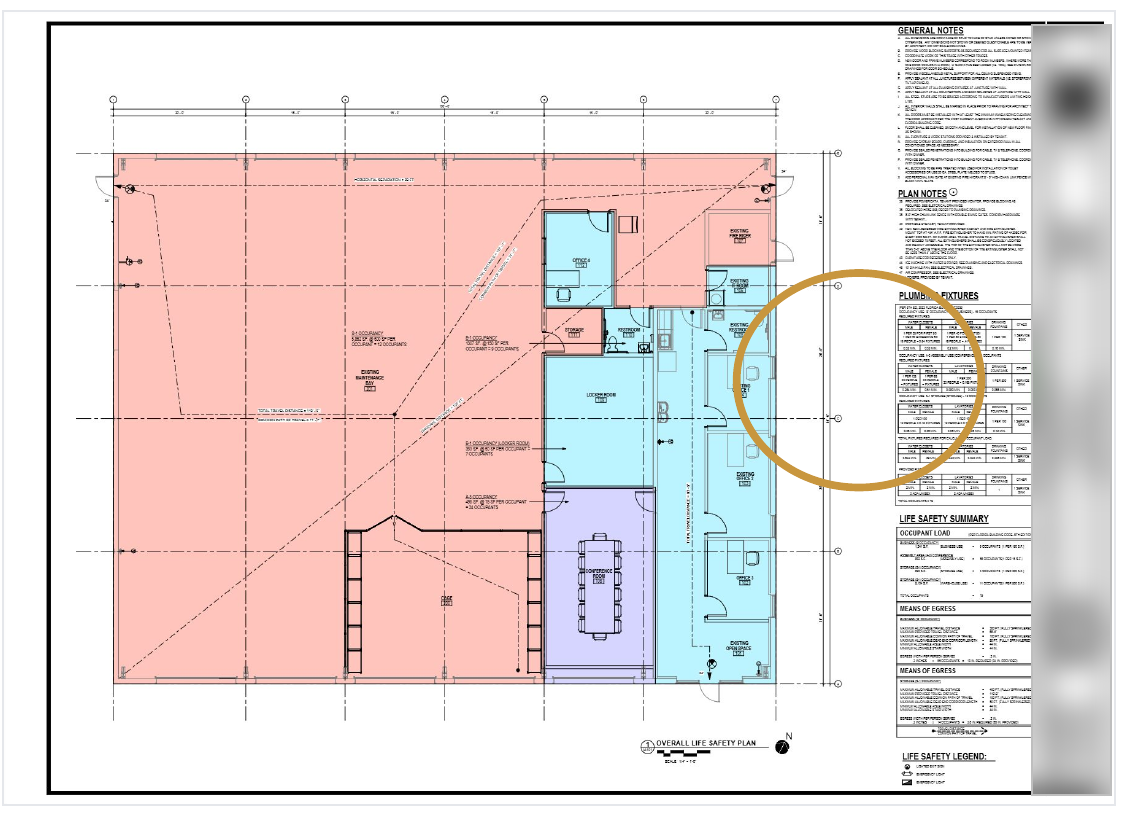
These screenshots come from a real PREiQ™ analysis of a commercial tenant improvement project — not a mockup. The engine read 21 pages across 4 files and found inconsistent occupant load figures, an unindexed structural reference, a project address that didn't match its stated jurisdiction, and equipment loads that exceeded the stated project scope — the kind of issues that generate review comments and cost weeks of resubmission time.
Every one of these was caught before the project was ever submitted.
Inside permitOS, PREiQ™ answers to Goldie — named for the Gold Standard expeditors whose review process taught it what a plan reviewer actually flags.

27 issues surfaced before submission — generated automatically, no manual review required.
On Sheet IA000 (cover), the Code Information table lists Business = 1,640 S.F., Assembly (A-3) = 498 S.F., Storage (S-1) = 5,862 S.F., and “Total Tenant Suite S.F.” = 2,073 S.F. — which does not equal 1,640 + 498. On Sheet IA101, the Life Safety Summary “Occupant Load” box uses different areas entirely (Business 1,241 S.F., Assembly 832 S.F., Storage 823 S.F. + 5,104 S.F.), while the room-by-room area callouts on the same floor plan match the cover sheet, not the summary box.
Why it matters: these three data sets disagree, and the resulting occupant totals — 62 versus 79 versus 65 — directly drive egress width, common path of travel distance, and plumbing fixture counts.
Sheets cited: IA000, IA101
Findings are triaged the way an experienced expeditor would prioritize them — so you fix what matters first.
Blockers are issues that will stop a plan reviewer cold. Advisories are worth knowing about but won't hold up your permit. PREiQ™ tells you which is which, instead of leaving you to guess.
Most plan review comments are not code violations. They are local ordinances, jurisdiction-specific submittal requirements, and the things a particular department asks for every single time. A national code engine cannot see those, because they were never in the code to begin with.
The Florida Building Code and the referenced standards — NFPA, NEC, FBC Accessibility, the Energy Conservation Code — checked sheet by sheet against what is actually drawn.
Local amendments and ordinances on top of the code: a city's Engineering Standards Manual, its Land Development Code, impervious surface ratios, bufferyards, its own mandated file names and submittal forms.
Eight years of Florida AHJ review data. What this department has actually flagged, on jobs like yours, over and over. Not what the code permits — what this reviewer calls out.
That third layer is not only data. Donn Sharpe, our Director of Special Projects, spent twelve years in permitting — including a stretch as a zoning supervisor for Orange County, the jurisdiction PREiQ™ knows best. He has read these comments from the other side of the desk.
PREiQ™ is not trained on permits everywhere. It is trained on the same Florida jurisdictions, the same departments, and the same named reviewers, filing after filing, since 2019. A national dataset a hundred times larger still knows nothing about what Orange County Fire flagged last week.
years of review history
2019 through 2026
Florida jurisdictions
counties and municipalities
named AHJ reviewers
tracked by department
review documents
in Orange County alone
A competitor can license a code library. Nobody can license this. It only exists because somebody filed the permits, read every comment, and kept the correspondence — and it gets deeper every week.
The Permit Readiness Engine is built from real Florida review comments — not generic code language — across every discipline a permit package touches.
Code editions, product approvals, structural references, and sheet indexing gaps.
Fire department connections, hydrant spacing, fire flow calculations, and occupant load consistency.
Fixture counts, equipment loads, transfer air paths, and scope-of-work mismatches.
Panel schedules, new equipment circuits, and loads that exceed the stated project scope.
Setbacks, flood zone compliance, drainage, and right-of-way utilization requirements.
Zoning district limits, jurisdiction mismatches, and local amendments specific to the AHJ.
PREiQ™ changes often. See what’s new in permitOS for the dated log of everything that has landed.